Thursday, December 20, 2012

Commemorating the Death of Julius Caesar


(15 March 30 A.D.)
As you all know, it is the 14th anniversary of Julius Caesar’s death. And although, towards the end of his rule the citizens of Rome were unhappy with his dictatorship, he glorified and contributed so much to this city. In honor of the anniversary of his death we talked to two experts on his life. Suetonius and Plutarch. We talk about Caesar’s personal characteristics and reforms to the Roman empire with Suetonius and Plutarch gives us insight into Caesar’s death.
Me: Hello Gentlemen. In honor of the anniversary of Julius Caesar’s death, I’d like to ask you a few questions about him. Let’s start with his person attributes shall we?
Suetonius: Thank you for having us. Physically, Caesar was tall, fair, and well-built. He had a broad face and keen looking brown eyes.
Me: Did he also dress non-traditionally? Could you tell me more about that?
Suetonius: The way he dressed was unusual; he added wrist-length sleeves with fringes to his purple striped senatorial tunic. He wore a belt over his tunic, but had it fastened loosely
Me: Not tying it tightly was his way of expressing his dominance, correct?
Suetonius: Indeed.
Me: How was he as a military leader? We've all, at some point, heard praise about Caesar as a general. Does he deserve the praise he receives?
Suetonius: Yes I think he does. "Caesar was a most skillful swordsman and horseman, and showed surprising powers of endurance. It is a disputable point which was the more remarkable when he went to war: his caution or his daring." He never exposed his army to ambushes, but made careful attacks.
Me: Was he good to his soldiers? Were they loyal to him?
Suetonius: "Sometimes, if a victory had been complete enough, he relieved the troops of all military duties and let them carry on as wildly as they pleased. He addressed them not as ‘My soldiers’ but as ‘Comrades ….’, which put them in good humor".
Me: So do you think that it’s possible that he could have won their loyalty through his interactions with them?
Suetonius: Yes it is by these means he won the devotion of his army. Throughout the entire struggle of the Civil War not a single Cesarean deserted.
Me: After he won the civil war, Caesar returned to Rome and declared himself dictator for life. While he was dictator, what kind of reforms did he attempt?
Suetonius:  Well first, he reorganized the calendar which the College of Priests, had allowed to fall into such disorder, by inserting days, or months as it suited them. Caesar lengthened the year so it fit with the course of the Sun.
Me: How about  his reforms in the Senate?
Suetonius: He strengthened the Senate by increasing the number of members within it. He created new patricians, and increased the yearly quota of praetors, aediles, and quaestors, as well as of minor officials. He also arranged the commons so that half of the magistrates, not including the Consul, had to be elected and the other half had to be nominated by him.
Me: Didn't he also encourage education?
Suetonius: Yes he did. In order to encourage medical doctors and professors of liberal arts to stay in Rome, and encourage others to both pursue the career paths or migrate to Rome, he granted them citizenship.
Me: Thank you so much for your time Suetonius. Let’s now talk to Plutarch about Caesar’s death. Thank you for coming sir. What happened during the day that led up to his murder?
Plutarch: Caesar put off anything of importance pretending to be sick the day of his murder because of the ill-omens that attended his sacrifice.
Me: How did the group that killed Caesar set up for it?
Plutarch: When the senate went into the chamber to find where they sat, the company wishing to murder him sat close to Caesar’s chair.
Me: How did they go about actually murdering him?
Plutarch: When Caesar entered the whole senate rose up to him and when he sat down everyone crowded around him. They  set Tillius Climber to be in place of his brother. They all joined prayers with him, and took Caesar by the hand and kissed his head and his breast. He told them to stop and they didn’t stop, angering him. Caesar stood up abruptly and Tilius grabbed Caesar’s hands and pulled his robe of his shoulders.  And after that they all attacked him s viciously that they even cut each other and by the end they were all covered in blood.
Me: Who landed the first blow? What were his last words?
Plutarch: Casca made a shallow wound on his shoulder and the Ceasar cried out in Latin, “ Villian Casca, what do you?”  Calling for his brother to come help him, but by that time, he was already being attacked.
Me: That was the fall of Julius Caesar, our self- proclaimed dictator. Thank you so much, men. Please remember him in your prayers.

Wednesday, December 19, 2012

Literature Thief Attempts to Steal Credit for Famous Writer’s Works


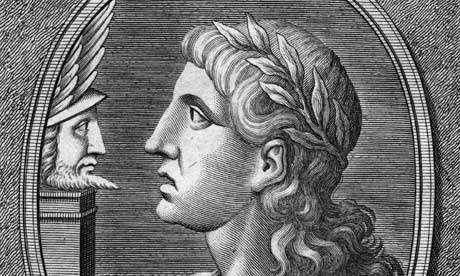
Pictured Above: Publius Vergilius Maro

(17 December 19 B.C.)
Since our land is in such a time of peace and prosperity the works of literature have flourished and blossomed. Our many poets and epic writers increase our cultural scope of life and liberty here in Rome. A man by the name of Samuelus Niratious has attempted to steal credit for writing the great epic the Aeneid. Publius Vergilius Maro, better known as Virgil, is the great author responsible for the work of the Aeneid, but Samuelus has claimed that he wrote the book and Virgil has stolen it from him. This is an absurd idea, because Samuelus claims that he and Virgil were close friends but Virgil is a man who keeps to himself and avoids the spotlight. Virgil has few close friends, and the fact that Samuelus did not receive the proper education to have the ability to write such a beautiful epic. The Aeneid has helped our Roman children and students learn the language of Latin and learn many lessons along with being a great epic. With all of these great things the writing has done there is no possible way that Samuelus could even attempt to write an epic of such caliber.
Pictured Above: Quintus Horatius Flaccus
          Another man by the name of Ronaldo Carbinicus has claimed to be responsible for the poems of Quintus Horatius Flaccus, better known as Horace. Carbinicus claims that he wrote these poems and that Horace is a lying man who must not be trusted in this society. According to Carbinicus, he wrote the Carmen Saeculare, after Augustus assigned the duty of writing that poem to Horace in preparation for the Secular Games. He also claims that Augustus made a grand mistake by granting amnesty for those who took part in the civil war after the assassination of his great uncle, Julius Caesar. Horace was one of these many people who were granted amnesty because of their wrongful affiliations in the civil war.
            Earlier this week both of these men were imprisoned for their lies and slander upon the authors, and Horace and Virgil were given full credit for their literary work.

New Treatments for Common Ailments


Have you ever suffered from a headache that never seems to go away or not being able to see the way you used to? On Tuesday Milanicus Warfus announced two procedures that are now going to be available to the average Roman citizen.
                Warfus tells us that they have been testing the first one, Trepanation, on slaves and now, due to the high survival rate, him and his colleagues feel that it’s safe to make it available to the average Roman.
                During Trepanation, the surgeon creates a hole into the patient’s skull using a special saw-like tool. This surgery increases the blood flow to the brain as well as decreasing pressure that might be present in the brain.
                Warfus believes that this procedure will cure epilepsy, a disorder that causes a person to experience many seizures. A seizure is a violent attack that makes the afflicted person look as though he is possessed an Jupiter is rattling his soul around in his body.
                This surgery, according to Warfus, cures migraines. Migraines are headaches that feel as though Pluto has unleashed his fury within your skull. They are also recurring and happen at frequent intervals. If you or a loved one is experiencing any of these symptoms he urges you to go to your nearest surgeon and as for a Trepanation
                The second surgery he calls cataract surgery.  He says that a cataract is a clouding of the lens of the eye and makes thus makes one’s vision blurry. To help break up the cataract the surgeon inserts a thin, hollow needle into the tissue of the eye, but only through the surface. The surgeon then uses the needle to break up the cataract. After the cataract is broken up, the surgeon suctions out the pieces of the broken cataract through the hollowed out part of the needle.
                Warfus says that the surgery has been tested on slaves and has a moderate rate of vision improvement for the patient.
                If you think you are ailed with worsening vision or dark spots, Milanicus Warfus has a series of associates, and he’s sure to have one near you.

Tuesday, December 18, 2012

Foolish Upheavals Against Our Emperor


(December 16, 12 A.D.)
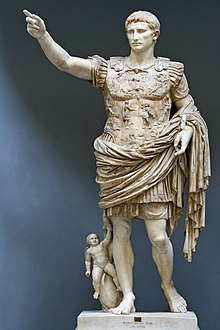
Being the great nephew of Julius Caesar, Augustus knew that he would become a great leader. Although unlike Caesar he changed his governmental system to a style he named Principate. In Principate there is a monarchy but the ruler remains in power for life. Unlike his great uncle, Augustus was able to control and set the Republic back to a state of peace and lawfulness. With this known fact then why are some citizens stating in open marketplaces that our Roman Empire would be better if it was controlled and ran by a dictator and not Augustus? This small group of people have went all around central Roman marketplaces preaching their ideals and that they want to set the government back to a Republic with a dictator. Let me remind you what happened the last time we had a dictator and how the innovations of Augustus have helped our economy and empire.
 During the times of Caesar as we all know, the Republic was at a time of anarchy. Generals committed extortion and stole money from everyday citizens, and occasionally resorted to intimidating the senate by using the Roman army to influence the voting assemblies. In the time of Caesar people would settle disputes through fights and brawls rather than negotiation, and the city of Rome was uncontrollable. This restlessness inside of Rome led to the Civil War between Pompey and Caesar. When Caesar had complete control as dictator over Rome, he did little to settle the internal problems of Rome. Caesar even planned to leave Rome for a few years to campaign against the Parthians in the last few months of his life.
On the other hand Augustus, the great nephew of Caesar, controlled Rome with a much more fair and powerful way. Becoming the first emperor of Rome, Augustus was able to stop 100 years of civil war and put our great land in a state of peace and prosperity. He was able to assemble an army of 28 legions. He then gave these soldiers wages and rewards after being discharged. For the first time in Roman history being a soldier turned into a true profession. He then made all troops take oaths of loyalty and he usually only made commanders people of his family or close friends. Augustus is the best military leader we have ever seen. His military genius allowed him to create a standing army abroad. This abroad army led an expansion campaign made to protect Rome from enemies and possible invaders beyond the frontiers. Of course we cannot forget the battle of Actium in which Augustus defended us from Cleopatra and Marc Antony, the traitor. After his performance in the battle of Actium we had no choice but to allow him to lead our empire. As ruler he has changed Rome from a Republic to an Empire, and nearly doubled the size of Rome. He has conquered various territories in Europe and Asia Minor. He restored internal structure inside of Rome by founding his own governmental system. Augustus “found Rome a city of bricks, and left it a city of marble” as he made it much more strong and powerful. Along from being the great military leader that we all know him as, Augustus is also a very well educated man. He has founded many buildings of art and architecture such as the Forum, the Ara Pacis Augustae, and the multiple buildings in the Campus Martius. Also during his time as ruler many famous writers came to be known such as Vergil, Horace, Ovid, Tibullus, and of course the great C. Maecenas. C. Maecenas was actually a great long time friend of Augustus. He was also able to create many more bridges, highways, aqueducts, and an efficient postal system. Let’s not forget that because of our great leader Augustus, “the exalted one”, we would not be living in this state of peace and prosperity.


A Tourist's Guide to Roman Food


Balls of semolina and curds, a traditional Roman dish.
(August 30, 30 BC)
Planning a trip to Rome soon? Well, in case you didn’t already know, there’s one thing that brings Romans together like no other: food! After all, cuisine is one of the defining factors of a population. So don’t make the wrong dining decisions during your visit! With such a wide variety of dining options, you’ll see that size is not the only field the Roman Empire is unparalleled in! Whether you are visiting from the deserts of Egypt or the cities of Spain, you’re sure to find your new favorite food here in Rome.  And remember; don’t get stuck at the tourist traps! When in Rome, eat as the Romans eat!
            Are you a fan of breakfast at home? Hope you brought a thick wallet. In Rome, only the rich eat proper breakfasts. Slaves and peasants are often left with only water as their morning meal. However, if you can afford the luxury, you will be treated to a dining experience like no other. In Rome, breakfast is known as Ientaculum and is eaten very early in the morning. Staples to Ientaculum include salted bread, honey, and dried fruits. One of the most common (and basic) Roman breakfast practices is to drench the bread in the honey, creating a delicious sweet and salty combination. Even better, it is one of the easiest recipes out there; so if you just can’t wait for your trip to Rome, give this succulent combo a shot before you arrive for a taste of Rome, at home! Much like the Roman slaves, the rich drink plain water at the morning meal as well. After all, the rich can’t always consume the most luxurious foods! Nevertheless, the rich are generous here in Rome, as it is tradition to donate food for the morning meal to the needy. Although they would rarely give anything more luxurious than plain bread, it is still a great act of kindness towards the less fortunate. For the ultra-rich, olives and cheese were also common at Ientaculum. Salivating already? We’re not done yet!
            Lunch is the least glamorous meal in Rome, as it is often made up of the previous night’s leftovers. Often referred to as Prandium, it is only eaten by the rich, much like Ientaculum. This is mainly because lower class citizens can’t afford to take time out of the middle of their workday to eat a full meal. However, for those who can afford the meal, it is made up of many of the same foods that are eaten at the evening’s meal, such as breads and cold cuts of assorted meats. It can also include fruits and vegetables, cheeses, and other proteins such as fish. Although this seems to be a rather light meal, most Romans can cope with it since the evening’s meal is served relatively early and lasts for a long while, often late into the night. So let’s talk about Rome’s most grand meal of the day!
            The evening meal, otherwise called Cena, is the most intricate and elaborate meal in Rome, often consisting of many courses for the rich. For the poor, it is often a meal of wheat, whether in the form of bread or porridge. Occasionally, they also have honey to add to the wheat for some flavor. However, for the rich, Cena is a party unlike all others. To begin, the rich eat a small first course called Gustatio. It is often composed of veggies like radishes and mushrooms. In addition, there is also protein in the Gustatio like sardines and oysters. After all, with all of Rome’s coastline, we have the best seafood! Once the Gustatio ends, the main course, or Prima Mensa, is served. At this time, men traditionally sit at the table on couches and recline while they eat. Women and children, however, do not have this privilege, and sit on wooden stools while they eat. Prima Mensa is primarily a meal of proteins, including fish like eels, turbot, and mackerel, and shellfish. In addition, they eat red meat such as beef, venison, and veal. Often times, these proteins would be steamed, roasted, and, occasionally, even fried! One tip on customs during these meals: belching is considered respectful and polite! This is just an interesting custom to top off a great Roman meal. After the main course comes dessert, also known as Secunda Mensa. It is generally made up of cakes filled with honey and flavored with fruits. Two of the most popular Secunda Mensa dishes are stuffed dates and a concoction of poppy-seeds and honey. Sweet! After the end of Secunda Mensa, the meal ends with a round of diluted wine for all of the diners, except the women. Traditionally, women could only drink if their alcohol was extremely diluted, even more than everyone else’s drinks. At this point, the meal ends, but the party continues into the night as entertainers fill the dining hall to amuse the guests.
           So don't just settle for the plain old food in your homeland! Spice up your life by visiting Rome and dining with us, today!
            

Mark Antony Commits Suicide


(August 31, 30 BC)
            Remember what it was like, only 13 years ago, to be ruled by a single man? Remember how the entire republic reacted? Remember how powerless the people felt to know that one opinion could change their life forever? Well, in case you can’t recall any of these feelings, don’t fret: you may have the chance to relive them. On August 12, Mark Antony committed suicide alongside his lover, Cleopatra, in Egypt. Antony, who was previously a military general under Caesar’s rule, more recently led alongside imperator Octavian. However, his death leaves Octavian as the only ruler of Rome, leading many to believe that this may be the start of another Roman dictatorship. And, judging from what happened to our last dictator, I hope that he has some well-trained bodyguards.
            Although Antony was an extremely successful general under Caesar, and even aided the Republic more recently, leading the Second Triumvirate in the battle of Phillippi in 42. During the battle, the triumvirate fought against Caesar’s murderers, Brutus and Cassius in an attempt to repay them for murdering the famous dictator. However, it would be Antony’s leadership that would win the battle for the republic. By breaking through a blockade of soldiers protecting Brutus’ and Cassius’ camp, he was able to infiltrate the enemy camp. This inventive tactic ensured the Roman victory. With Julius Caesar’s death avenged, the two returned to Rome. However, this would be the end of peaceful times between the two leaders.
            As Octavian settled his troops back in Italy, Antony was once again dispatched to fight, this time against Parthia. To gain Egyptian support for the war, Antony established a relationship with Cleopatra, the Ptolemaic queen of Egypt. This was only the beginning of his life with the Egyptian Queen, however, as they began to join together not only politically, but romantically, too. In 37, the two got married.
            It was the beginning of the end.
            Since Antony gradually spent more time in Egypt solving their affairs, Octavian began to view him as an enemy, betraying Rome to help Egypt. With the intention to kill Antony and his lover, he began to chase the two around the Roman Empire.
            After gaining the support of the Roman army, Octavian finally attacked the Egyptian army along with Antony and Cleopatra in Greece, at the Battle of Actium. Knowing that his army had no chance of winning, Antony and Cleopatra fled back to Egypt, and after being captured, the two killed themselves with their own swords.
            It truly is a sad day in Rome, as we not only have lost a leader, but, even worse, we may have lost a republican governmental system in the process.